We left the Ramada Inn for our scoot ‘down east’ shortly after 7 (Dennis, our ‘road capt’ likes to get an early start). We would have left earlier except yours truly overslept due staying up until 3 trying to figure out the posting format for this blog. I made the mistake of upgrading which gives more options but with that comes complexity that runs afoul with my low tech capabilities.
We continued along Rt 1 through Sullivan near where I went to camp as your lad at Buckskin Camp for Boys on Donnell Pond. It was there that I spent time with a Maine guide, George Harriman, who took me fishing to most of the ponds and lakes in this area and taught me so much about life and self-reliance – – – George Harriman epitomized Emerson’s essay on Self-Reliance. This is definitely a byway that is less traveled. You pass modest homes in the woods with lobster pots and pickup trucks packed outside and folks advertising in their yards of what they can do for you, like one chap who’s handmade sign read – – -“Land surveyor, water testing and septics”. Now that is a guy you want to know!
We passed over some of the iconic Atlantic salmon fishing rivers in the NE – – – Narraguagus, Pleasant, Machias – – – who’s salmon runs are but a trickle of their former greatness. A sad testimonial of changes in our world today.
But the good thing for me is to see that things in this part of the world have not changed that much, except maybe for the blueberry farms. The blueberry fields used to be these open fields with Maine granite boulders interspaced with low-bush blueberries. And all the blueberries were picked (raked) by hand with a blueberry rake. Not anymore. Blueberry farming has gone mainstream and mechanized. The granite rocks have been removed and the hybrid low-bush blueberry bushes are now harvested by machines. Blueberries have definitely gone agribiz.
On our way ‘down east’ John and the gang wanted to visit the most eastern city in the US – – Lubec, ME. So at Whiting we turned off Rt 1 and went really ‘down east’ to Lubec – – – a small town situated at the western end of the bridge which crosses over to Canada’s Campobello Island. (Like the reverse of Pt. Roberts in WA where you have to go thru BC to get to Pt. Roberts) Campobello Island is at the entrance to Passamaquoddy Bay and where FDR spent considerable time at the family retreat on the island which dates back to 1883. The Roosevelt’s 34-room “cottage” was acquired in 1952 by Armand Hammer and his brother who eventually donated the estate to the US and Canadian governments as an international park.
The most easterly point in the US is actually at Quoddy Head at 44-48.9 N, 66-57.1 W. There is a stately lighthouse on the point that was first constructed in 1808. We took the twisting road out to the head to see the lighthouse and stand on the most easterly point in the continental US. At the time the tide was running hard into Passamaquoddy Bay and the Bay of Fundy – – – an amazing sight see and experience. It is easy to understand why there has been talk for so many years about generating electricity with this tidal activity.
Eventually we got to the border at Calais, ME and crossed over without incident into Canada at St. Stevens, New Brunswick. One of the first things that struck me was state of Rt 1 in Canada compared to the US Rt 1 in Maine. The Canadian Rt 1 was a 4-lane modern highway while Rt 1 in Maine is a twisting, 2-lane rural road. Granted the Canadian Rt 1 leads west from the sizable city of Saint John but still the change is dramatic and noticeable. We had to make time so we picked up the pass going east up the Bay of Fundy to Penobsquis where we turned SE over the hills through Fundy National Park to the small town of Alma on the Bay of Fundy.
There is not much in Alma except a few motels, gas station, general store, post office, bakery and a couple a couple of eateries. Most notable is the dock with a number of scallop boats that fish in the Bay of Fundy for the famous Digby scallops. It was tide was just starting to go out when we arrived in the afternoon with these boats floating high up along side the dock. By sundown the tide had gone out, the bay was dry and all these boats were resting on the muddy bottom. The interesting thing to John and me were that these boats were resting in a somewhat level position. Seems they devised a novel system of a “drydock stand” that they lower alongside the outboard hull midship and with a rope from the rail to the dock. Then as the tide does down, this “drydock stand” settles into the mud and provides a platform on which the hull can lean so that it stays upright. A very ingenious, inexpensive and effective means to allow boats to come to the dock, offload and remain at the dock at low tide with tipping over. My hat is off to whomever come up with this innovation.
The stay in Alma was very pleasant. Most of us had the local scallops for dinner and thoroughly enjoyed the nice change from lobster (We are really suffering!!) The only place that was open early was the bakery at 7. This of course was later than Dennis wanted to hit the road but we had to have our morning coffee so Dennis reluctantly agreed to mustering at 7 at the bakery.

The gang ready to leave Quoddy Head for the boarder

Jerry ready to ride with his “personality glasses” and his loud bike – – – all behold!
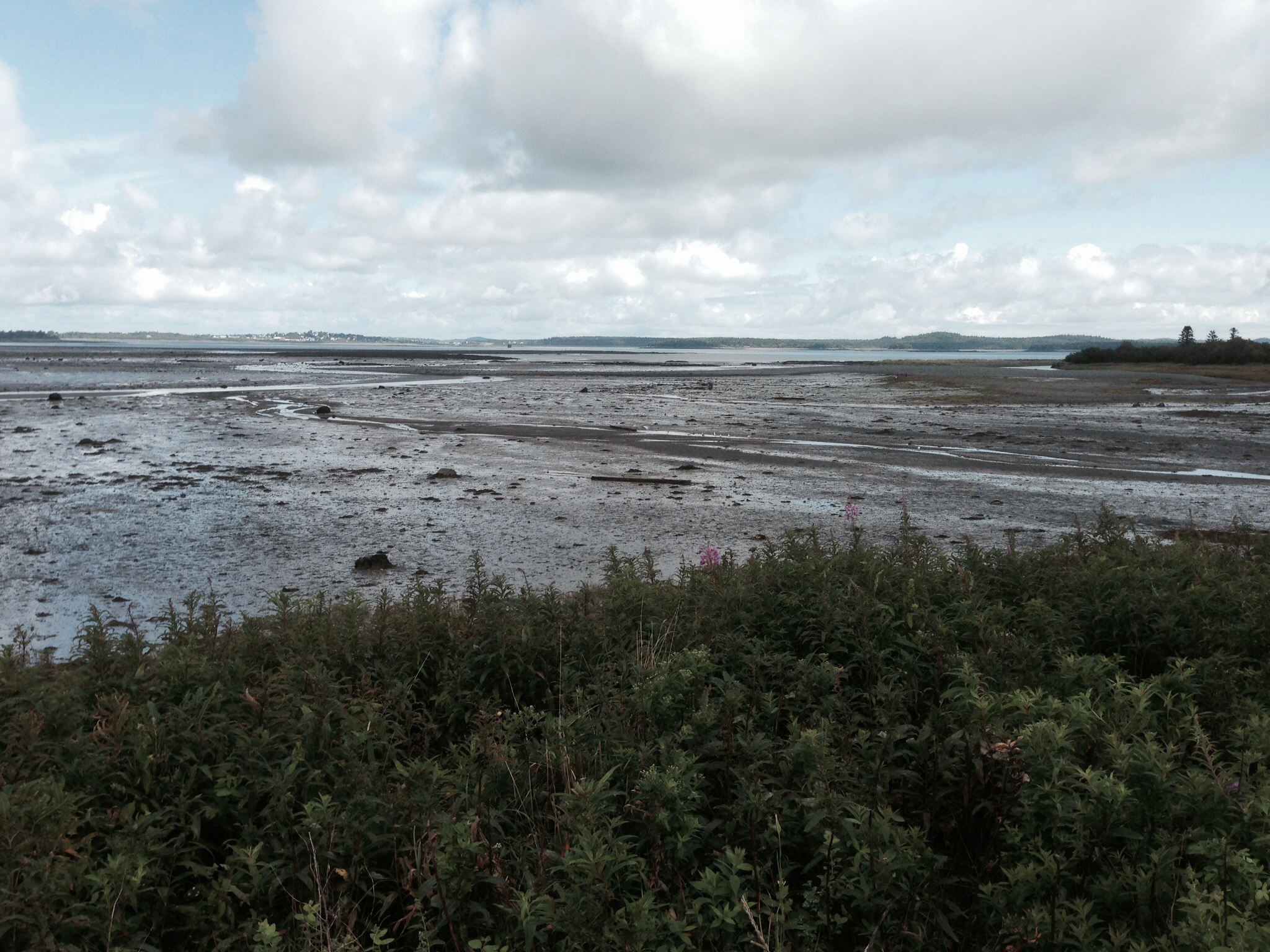
Low tide in Passamaquoddy Bay near Quoddy Head.

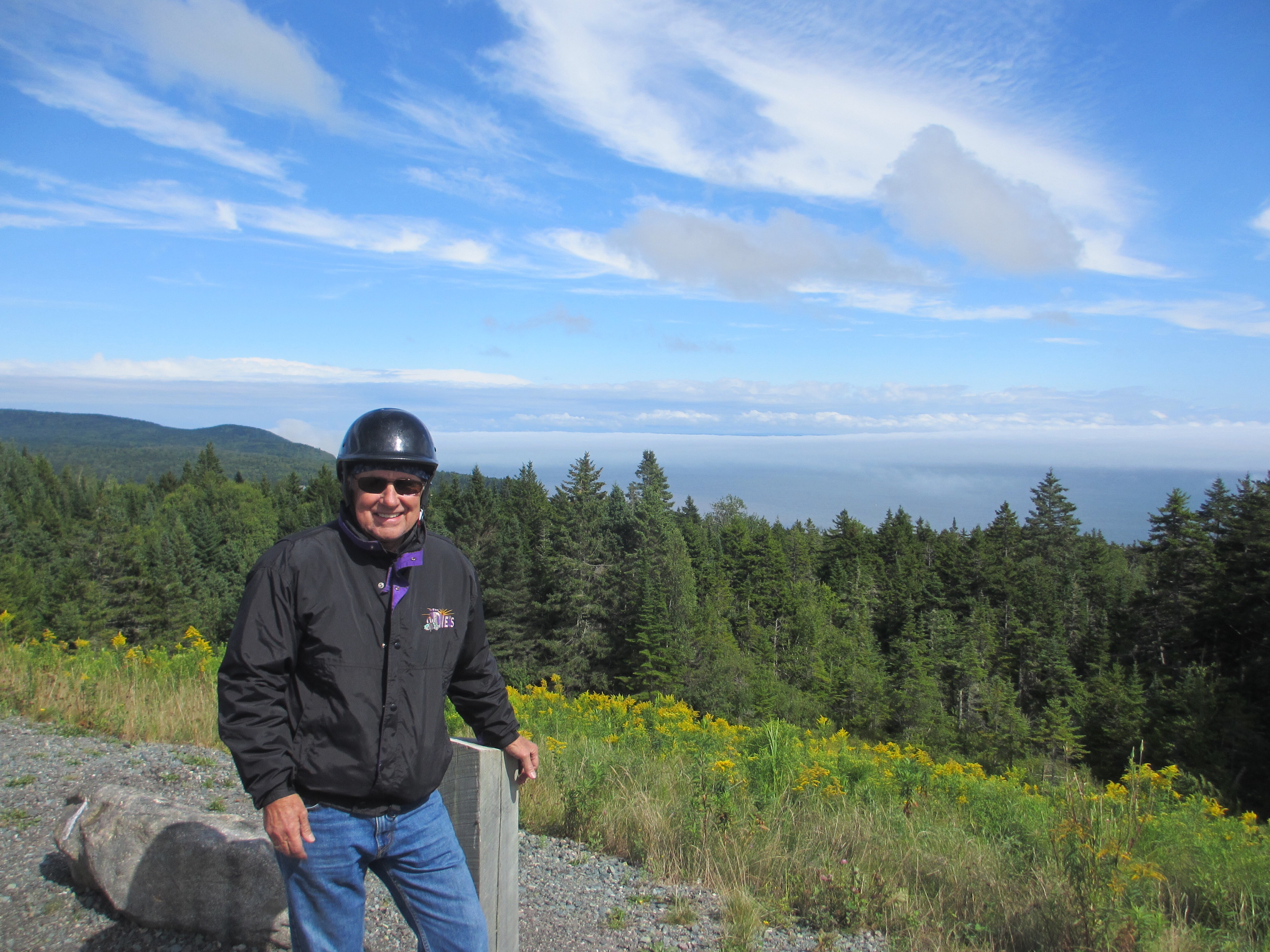
Along the Bay of Fundy

Scallop boats at high tide in Alma, NB
Dennis and Chris getting ready to get underway

Quoddy Head light. Most eastern point in the continental US.


“drydock cage” that keeps boats from tipping over when resting on the bottom at low tide

Scallop boats at low tide
 Boston to Labrador Ride